

Is your startup inevitable?
Why 'Why Now?' isn’t enough anymore. And, what to ask instead.

AI isn’t just another wave—it’s a time warp. What feels impossible today becomes default tomorrow. And those tomorrows show up faster than you think. That means the old ways of judging startups don’t always work. We learned that the hard way at Weekend Fund.
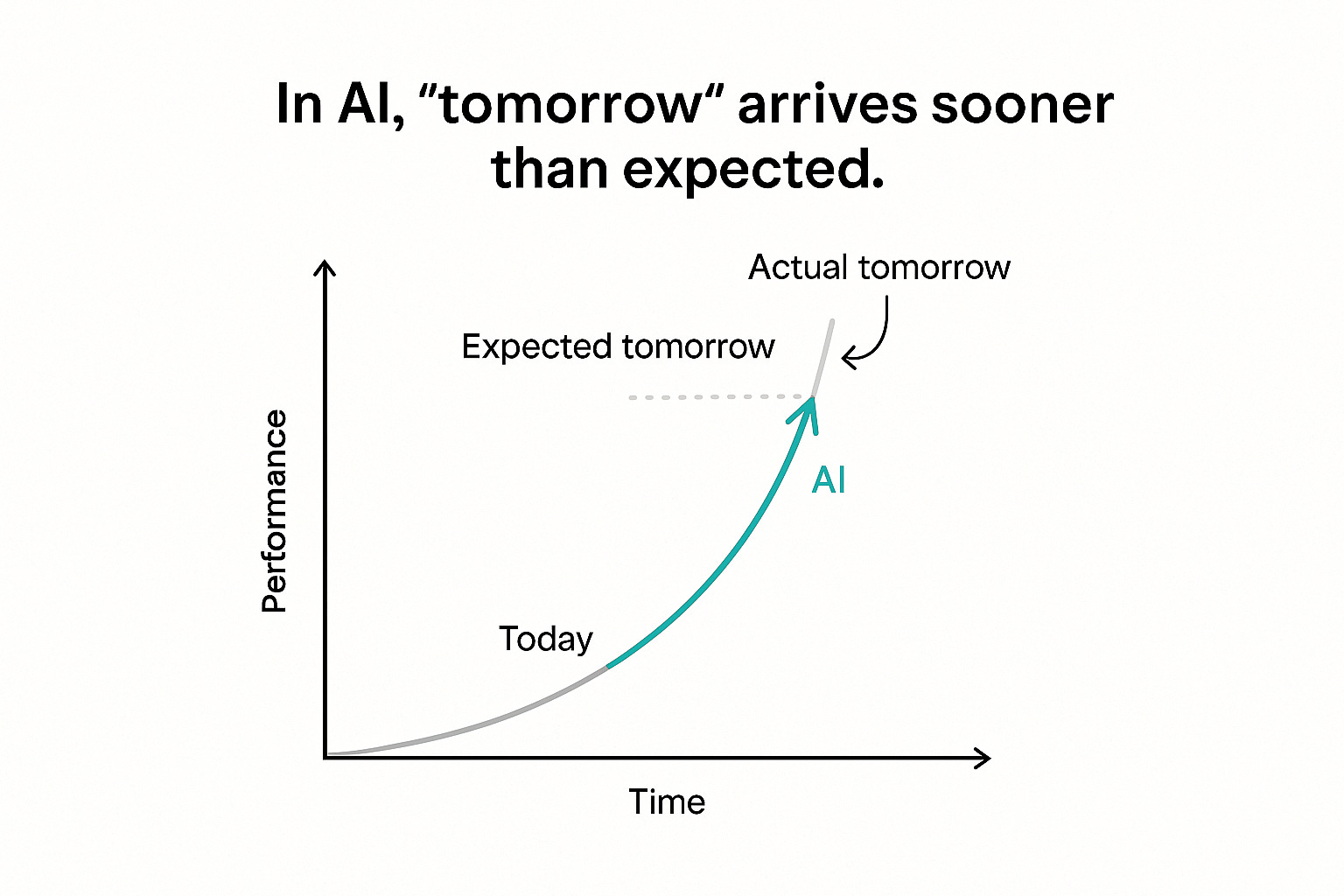
Last year, we passed on a few AI founders because they didn’t have user proof yet. Normally, that’s a reasonable call. But in AI, we’ve learned it’s not always the right one. The curve doesn’t crawl—it jumps. Token prices nosedive overnight. Latency gets chopped. Context windows explode.
OpenAI dropped token prices by ~80% in one update. Anthropic pushed context windows from 16k into the million-token club. GPT-4o now chats back in ~320ms—right at the ”Conversation OK” threshold.
Slope > snapshot
Judging a startup on its v1* is like reviewing a movie based on its storyboard. The better question is "How fast will v2 become great?". We’re looking at the slope, not snapshots.
We’ve seen this before in tech (though this is my first time seeing it from the investor seat). In 2005, YouTube started streaming videos at $9–$12 per GB. Crazy, right? But, they bet bandwidth would get cheap fast. It did. 18 months later, bandwidth was $1/GB, and Google scooped them up for $1.65B. Competitors who waited for costs to make sense never caught up. Wait became too late.
The same is true now in AI.
Why AI breaks the playbook
“General purpose” upgrades – One model API update improves legal memos, ad copy, and protein folding in the same morning.
Emergent jumps – Chain-of-thought reasoning and long context didn’t show up until models hit certain size cliffs. You can’t roadmap that.
Steep physics – Training compute has doubled every ~3.4 months since 2012 - 7× faster than Moore’s Law. Frontier models improve on something like a seven‑month clock.
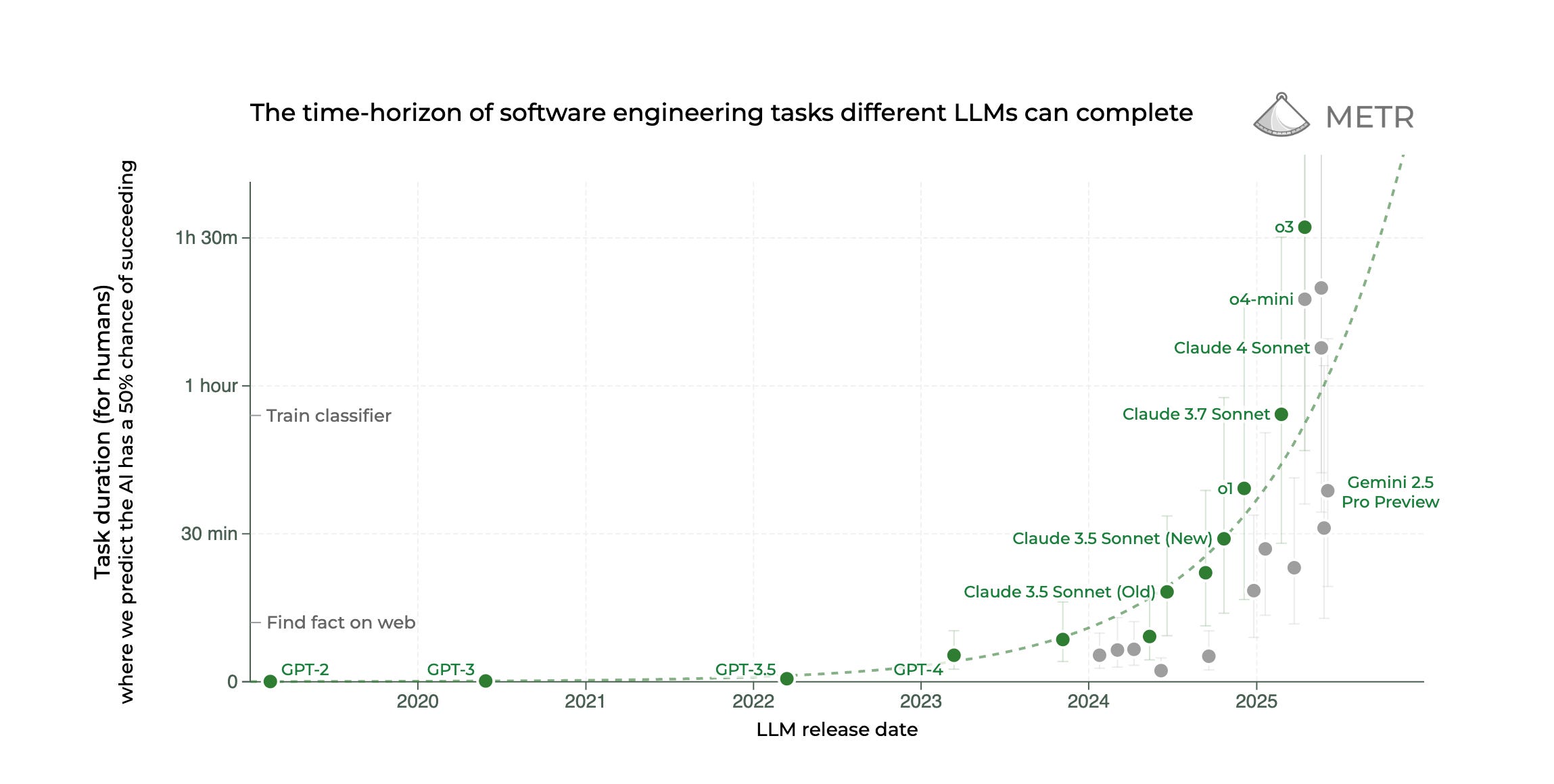
People still say “Code‑gen isn’t ready for enterprise,” or “AI SDRs fall apart after the first email.” Maybe so—today. But, that’s like yelling at a toddler for not having a LinkedIn.Most think in straight lines while the curve keeps bending.
From “Why Now?” to” Why Inevitable?”
At Weekend Fund, we’ve always asked “Why now?: what makes this moment the moment for your startup. But in AI, ‘now’ ages fast. We’ve layered on a second question: Why inevitable?
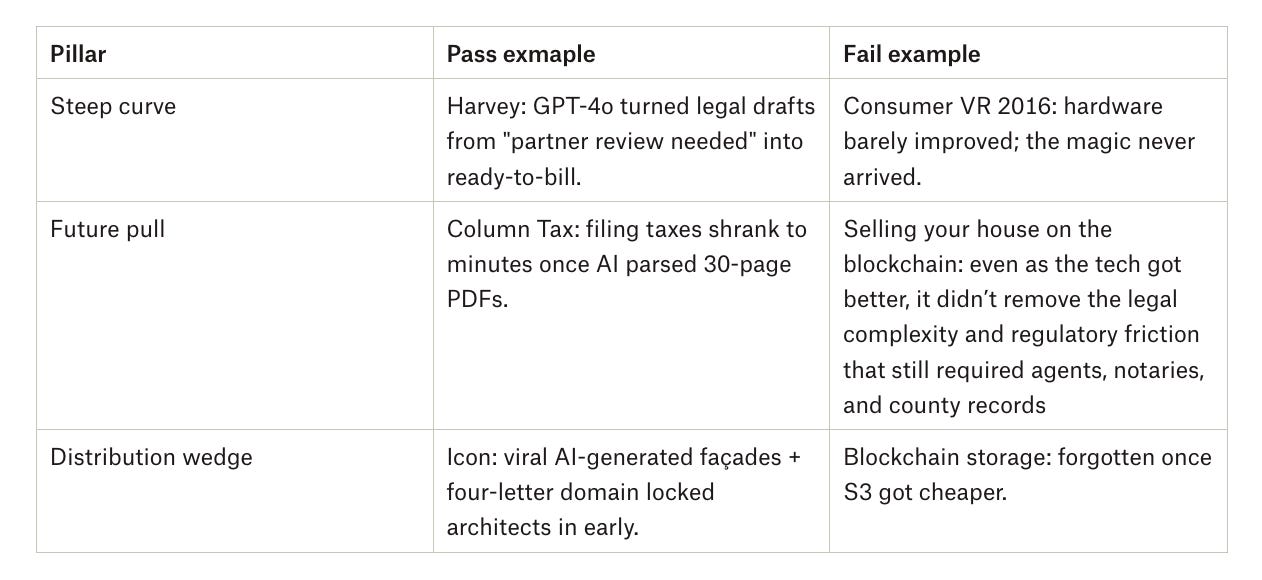
In AI, a startup feels inevitable when:
Steep curve: Its core tech is rapidly improving.
Future pull: A frustrating task goes away with the next model upgrade.
Distribution wedge: A team can lock in users or data before clones emerge.
When these combine, you get what Ethan Ding calls “levered beta”—a product that rides the tech curve, with growth amplified with distribution moves.
What this means for founders
Move with the curve. The best teams don’t wait. They:
Ship a solid v0.9 while users forgive rough edges.
Stay model agnostic. They don’t bet the farm on any one provider.
Track the curve. Keep a “capability backlog”: a running list of features that become viable once models cross some threshold X. For ex. if context windows double, that might unlock summarization features that you shelved as too compute-intensive.
Run weekly model sprints. Test new model checkpoints every Friday, launch on Monday if improvements are significant.
Measure everything. Track cost, latency, and quality. You dashboard can serve as an early warning system for model upgrades.
Take Notion: before context windows expanded, answering questions across multiple docs wasn’t feasible—models couldn’t handle that much information at once. As soon as they could, Notion shipped Q&A across your entire workspace.
Or Character.ai: when latency dropped, chat stopped feeling like work and started feeling like play. That shift made it sticky—users came back not just for answers, but for immersion.
Ask yourself
"What features become trivial if models improves 2x?"
"Which tasks disappear entirely with the next leap?"
"What distribution advantage can I lock in now?”
Watch for these blind spots
Commoditization: Assume your edge is temporary (e.g., chatbots becoming generic rapidly).
PMF confusion: Inevitable tech ≠ immediate demand. (e.g., advanced blockchain tech without user demand).
Over-polishing: Waiting for perfect means you miss the wedge. (e.g., late-to-market VR startups)
What this means for investors
AI collapses the gap between insight and readiness. In most industries, the pain is obvious—but the solution isn’t. AI flips that: the tools show up suddenly and work.
Here’s one example we keep coming back to. Take lawyers: they’ve hated drafting grunt work for decades. That’s insight. But it wasn’t until GPT-4o crossed a quality threshold that automated legal drafting became viable. That’s readiness. Harvey spotted this, shipped fast, and raised $300M at a $5B valuation within weeks. They moved before most people realized the tools were ready.
The challenge now is recognizing when the bar has been quietly cleared—and moving fast enough to claim the gap.
What this means for Weekend Fund:
Bet on the fundamentals: latency drops, context expands, costs fall. These are gravity. Back teams building for where the curve is going—not just reacting once it gets there.
Treat emergent leaps as bonus: back products that get way better when the new models drop.
Invest in readiness, not clairvoyance: favor teams that can pivot fast and ship often.
Hold a "leap reserve": have dry powder ready for when model upgrades unlocks PMF overnight.
Craft still matters - just the sequencing is new. We're not saying ship junk; we deeply value quality at Weekend Fund. Ship good enough to capture a wedge,then ride base model improvement from "good enough" to "obvious default."
I’m still working through this. Please send me counterexamples.
Building something inevitable? Email me at vedika@weekend.fund. We write $300-500K checks, weekdays, weekends, whenever.
Thanks to Ryan Hoover for reading drafts of this post.
*Yes, killer demos still matter. The viral link often becomes the default search result for your idea.